
Should Huntington University offer forestry as a major?
We're Foresters. It's on our jerseys, our logo, and 98 years of history. The question we're asking now is whether it should also be on a diploma. Tell us what you think.
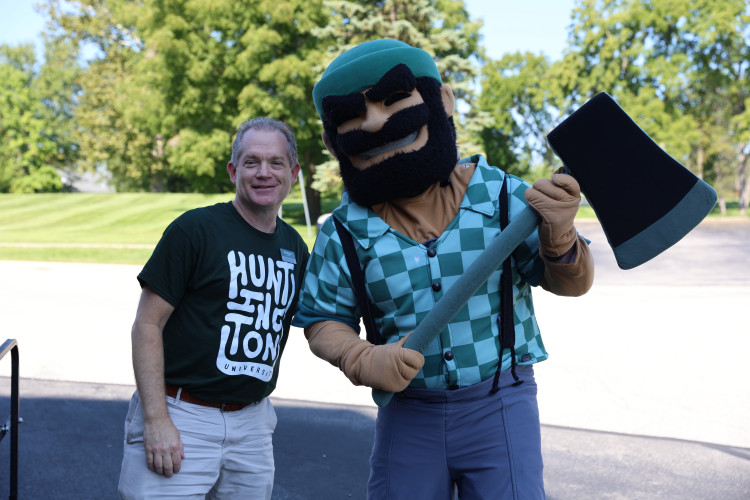
He's been a forester since 1928. We've never offered forestry.
The name was an accident. In 1928, a sportswriter named Cash Keller watched the Huntington College basketball team take the floor in Lincoln green and thought of Robin Hood's band of foresters. It stuck. Almost a century later, we've got a mascot in suspenders and boots, a full beard, and a campus in the middle of one of the largest hardwood economies in the country — and not a single forestry course. Maybe it's time the name meant something.
We're not announcing a program. We're asking about one.
Huntington University is exploring whether to build a forestry program — and whether it makes more sense as a full major or as a minor that pairs with degrees we already offer. Before we commit faculty, curriculum, and facilities, we want to know if there's real interest. This page is how we find out.
These are not distant industries. They're in Huntington County and the counties around it — small companies in small towns, run by families, looking for people who know timber and know how to run a business.
Indiana State Department of Agriculture, Hardwoods Division. in.gov/isda
Why Huntington
A forestry program here wouldn't start from scratch. HU already has an agriculture department with working relationships across northeast Indiana, a campus surrounded by the landowners and family businesses this industry runs on, and a Christ-centered approach to work that treats stewardship of land as a calling rather than a line item. Adding forestry is less a new direction than finishing a sentence we started in 1924.
What would it look like?
The form below asks you to choose between a major and a minor. Here's the difference, roughly.
A four-year degree in forestry — silviculture, forest measurement and inventory, wildlife and habitat management, timber markets, and the business side of running a forest operation. Graduates would work as consulting foresters, land managers, procurement foresters, or in state and federal agencies.
A focused set of forestry courses that pairs with a degree you're already pursuing — agribusiness, biology, environmental science, or business. Graduates would bring forestry knowledge into a career built on something else.
Tell us what you think.
Two minutes. No commitment. We're collecting interest, not applications.